Award season is here. Is your best project ready?
Every fall, the same thing happens in design studios. A deadline email lands, someone says "we should enter this year," and a week later the submission is half-done in a folder no one can find.
I've been on the other side of that folder. I put together a Luxe RED Awards submission for an interior design studio, and I learned fast that winning starts long before you hit submit. Four lessons stuck with me: the photos carry the entry, the category decides who you compete against, the short description is its own piece of writing, and early-bird rates are worth planning around.
This guide walks you through the whole process: choosing the right award, building the submission, and deciding what you should handle yourself versus hand off. The goal is simple. Get your best work in front of judges without losing a week of billable design time.
Why design awards are worth the effort
An award is marketing that keeps paying you back. A single win gives you a press mention, a badge for your website, social content for months, and a stronger story when a high-end client is comparing you to two other firms.
The reach can be significant. LUXE says RED Awards winners get exposure to a print audience of more than 1 million and digital channels reaching more than 3.2 million design enthusiasts (RED Awards 2026 FAQ). Interior Design magazine's Best of Year winners get a feature in the magazine and digital promotion (Best of Year Awards).
Even if you don't win, the work isn't wasted. The photos, narrative and project details you assemble become your portfolio page, your press kit and your next pitch to an editor.
Step 1: Pick the right award, not the biggest one
The best award to enter is the one where your project fits the category and the judges' taste. A strong residential project can disappear in a global program but stand out in a regional one.

Dates and fees change every cycle, so always confirm on the official page before you plan.
Three questions to choose from:
Does my project clearly fit one category, or am I forcing it?
Do past winners look like my work in scale, style and budget?
Where do my ideal clients actually see award winners: a magazine, a local chapter, or social media?
The submission process, step by step
Plan for four to six weeks from decision to submit. Most of that time goes to gathering things, not writing.
Read the rules twice. Note the eligibility window for project completion dates, image specs, word limits and who counts as the entrant. Some programs award only the lead firm, not the wider team.
Build a submission calendar. Work backward from the deadline. Set dates for photo selection, first draft, client approval and final upload. Mark the early-bird deadline first. If you want to save on entry fees, that is your real deadline.
Get permissions early. You need sign-off from the homeowner and the photographer. Many programs keep submitted content and publish it, so read the usage terms before you send anything.
Select your images. Have your professional photos ready before you start the form. Every image should be crisp, high-resolution and eye-catching, because judges decide in seconds. Choose a tight set: the wide hero shot, two or three details, and a before photo if the transformation is the story. Rename the files clearly.
Write the project narrative. Cover the client's brief, the challenge, your design response, and the result. Judges read dozens of these, so lead with the most interesting problem you solved. Most forms also ask for a short project description. Don't paste your pitch here: write a tighter version that works on its own, since it is often what gets published if you win.
Credit everyone correctly. List the photographer, architect, builder and key vendors exactly as they want to be named.
Proofread and submit a day early. Upload portals slow down on deadline day.
Plan the announcement now. Draft the social post, newsletter blurb and press note before results come out, so you can move fast if you win.
Mistakes that cost studios the win
Entering the wrong category. A great kitchen entered under full-home Interior Design competes against whole houses.
Too many photos. More images don't help. A weak photo pulls down the strong ones around it.
A narrative that lists finishes. Judges want the story and the problem you solved, not a spec sheet.
Missing permissions. A photographer or homeowner who says no at the last minute can end your entry.
Starting the week of the deadline. Rushed submissions show, and late fees add up.
Doing nothing with the entry afterward. Win or lose, that material should become a portfolio page and social content.
What to keep and what to hand off
You don't need to own the whole submission. You need to own the creative decisions. Everything else is project management, and that is the part that eats your week.
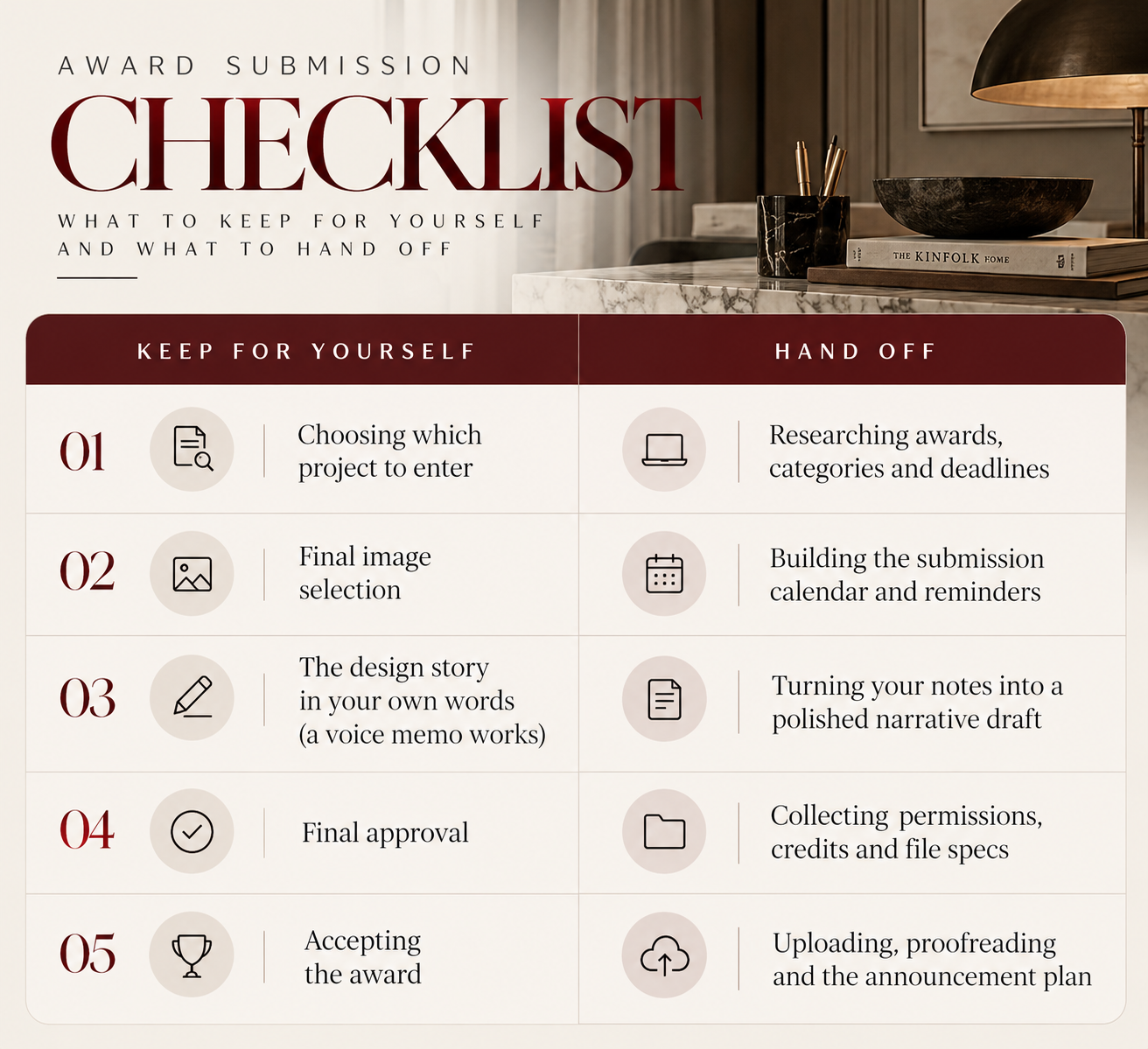
This is the work I do for design studios. I manage the submission from first research to final upload, so the designer spends a few focused hours on it instead of a lost week.
Your best work deserves to be seen
Awards reward the studios that prepare, not only the ones with the biggest projects. Pick one award, start six weeks out, and protect your design time by handing off the logistics.
If award season keeps landing on top of client deadlines, let's talk. I help interior design studios run submissions, pitches and operations so the principal can stay in the work.
email me at dee@thehybridva.com.
Frequently asked questions
-
4 to 6 weeks before the deadline gives you time for permissions, photo selection and a narrative draft without rushing.
-
It varies by program. Regional IIDA chapter awards, for example, have charged a few hundred dollars per entry, with lower rates for members. Always check the current fee schedule.
-
Some programs accept it, but professional photography is the single biggest factor in how judges see your work. If you're serious about winning, budget for it.
